The Standard and the Ring
What the Standard Said Before, and What It Says Now
The 2009 revision process altered the written standard for several brachycephalic breeds — but the distance between the Kennel Club's revised text and its FCI equivalents remains measurable.
A comparison of selected Kennel Club breed standards before and after the 2009 revision process — the specific language removed or added for brachycephalic breeds, and how the FCI standards for the same breeds have or have not moved in the same period.
Photo: Sarah Dorweiler / PexelsWhere the Language Changed
The Kennel Club's 2009 review of breed standards, conducted in the wake of the 2008 Pedigree Dogs Exposed broadcast and the Bateson review it prompted, produced amended standards for more than two hundred breeds. For the flat-faced breeds, the revisions were substantive. The bulldog standard, which had described a head "very large" in proportion with no qualification about respiratory function, gained a new clause requiring that the dog "should be able to breathe freely with no indication of breathing difficulty." The French bulldog standard was similarly amended; language that had previously celebrated extreme skull compression was offset by a welfare sentence affirming that any "respiratory distress" must constitute a fault. The pug's standard acquired comparable wording.
The mechanism of change was direct: the Kennel Club issued updated standards, effective from 2009, and required that judges penalise visible breathing impairment as a fault at licensed shows. The stated aim, as the Kennel Club documented in its published guidance at the time, was to ensure that the standard could not be read as endorsing a conformation whose functional consequences were harmful.

One placing, one judge.
Photo: Renan Rezende / Pexels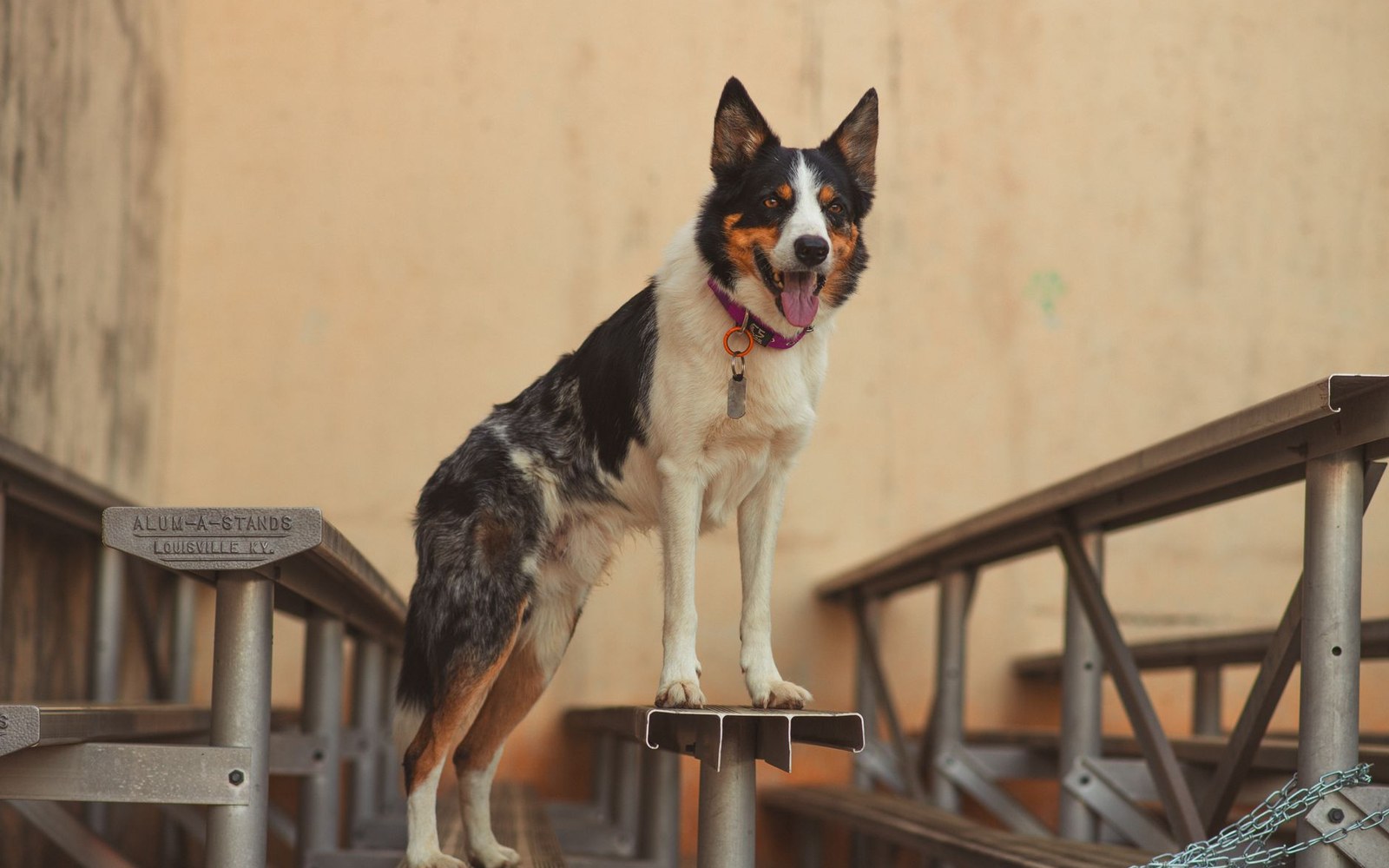
Bench numbers double as the day’s entry record.
Photo: Brixiv / PexelsWhat the revised language did not do was metrically define the level of intervention. There is no muzzle-length minimum in the KC standards, no skull-index ceiling, no requirement that dogs be graded before exhibition. That more prescriptive approach was taken later, and separately — the Respiratory Function Grading Scheme developed jointly by the Kennel Club and the University of Cambridge introduced the four-point scale assigning Grades 0 to 3 after a standardised exercise test, but participation remained a requirement only for certain health schemes rather than a universal condition of registration or entry.
How the FCI Text Compares
The Fédération Cynologique Internationale, which coordinates breed standards across more than ninety member countries and maintains its own standard documents, has not moved in lockstep with the Kennel Club revisions. The KC holds the role of standard-setter of record for British breeds under FCI arrangements, which means FCI members are formally bound by the KC text for breeds of British origin. In practice, the FCI standards for the bulldog, French bulldog and pug — classified under FCI Group 9 for the French bulldog and Group 2 for the bulldog — reflect the updated KC language where the KC is the country of origin and custodian. The welfare sentences introduced in 2009 therefore appear in those FCI-adopted texts.
Where the divergence is visible is in breeds whose country of origin is not the United Kingdom. For such breeds — the Pekingese, for instance, falls under KC registration but with a standard the FCI holds independently — the alignment is less automatic. Comparative evidence published by researchers including Rowena Packer at the Royal Veterinary College has consistently shown that standard language specifying preferred skull morphology continues to drive selection toward shorter muzzles regardless of welfare clauses, precisely because those clauses are subjective while the conformation descriptions are graphic.
Chronology
- 2008Pedigree Dogs Exposed broadcast; Bateson review commissioned
- 2009Kennel Club issues revised breed standards for 200+ breeds; welfare clauses added for brachycephalic breeds including bulldog, French bulldog, pug
- 2019Netherlands introduces minimum muzzle-length regulation (independent of standard system)
- 2023Borgarting Court of Appeal (Norway) finds English bulldog and cavalier King Charles spaniel breeding unlawful under animal-welfare law
The Norwegian and Dutch interventions subsequently went further than any standard revision: the Borgarting Court of Appeal in 2023 found that breeding English bulldogs and cavalier King Charles spaniels caused suffering under Norwegian animal-welfare law, while the Netherlands established a measurable muzzle-length rule in 2019. Neither instrument is a breed standard; both operate outside the kennel-club standard framework entirely.
The 2009 KC revisions remain the last general revision of brachycephalic-breed language within the UK standard system. The text now says that breathing difficulty is a fault. Whether judges, breeders and registrations have responded accordingly is a question the welfare literature has continued to answer — with consistent scepticism.
What changed in the language (selected examples)
| What changed in the language (selected examples) | What the record states |
|---|---|
| Bulldog | added requirement that dog "should be able to breathe freely with no indication of breathing difficulty" |
| French bulldog | "respiratory distress" specified as a fault |
| Pug | welfare sentence requiring absence of respiratory impairment added |
| All three | no metric definition (no muzzle index, no skull ratio) added; welfare clauses remain qualitative |